
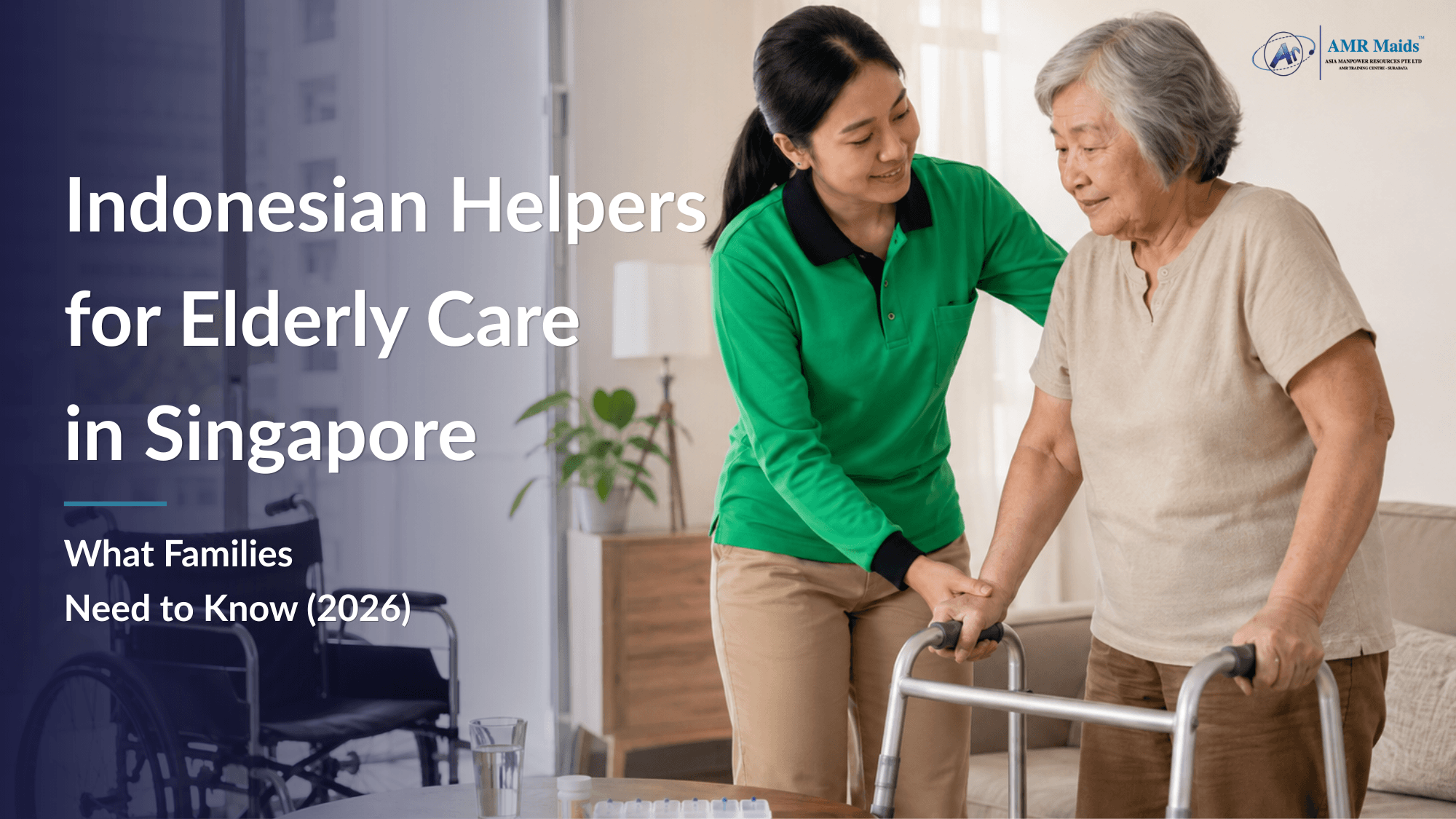
Indonesian helpers are well-suited to elderly care because of where they come from: multi-generational households where caring for grandparents is normal, and respect for elders runs deep. That cultural background translates into the patience, attentiveness, and comfort with personal care that eldercare actually demands.
- Indonesian helpers bring a natural cultural fit for eldercare. Multi-generational caregiving is the norm in Indonesian households, not the exception. Patience with slow movement and respect for elders tend to come built-in.
- They can handle all Activities of Daily Living — bathing, feeding, mobility, medication reminders. They cannot do anything clinical (injections, catheters, wound dressings). Know this boundary before day one.
- The most common screening mistake is asking generic questions. Ask for specific examples: what she did every morning, how she handled a wandering patient, how she would respond to a fall.
- Communication compatibility is a safety issue, not a preference. If your parent reverts to Hokkien or Teochew under stress, match her language background, not just her task skills.
- Training in the first 90 days is the single highest-return investment. Dementia communication, safe transfer, and CPR are all subsidised through the Caregivers Training Grant.
Why Consider Indonesian Helpers for Eldercare?
Cultural fit matters more than families expect
In Indonesian households, multi-generational living is the norm, not the exception. Many helpers have grown up watching over grandparents, feeding them, accompanying them to prayer, managing their daily routines, without any formal instruction. That upbringing means patience with slow movement, comfort with personal care, and tolerance for repetition tend to come more naturally than for caregivers without that background.
Respecting and deferring to older people is a deeply held cultural value in Indonesian society. In practical terms, this means helpers are less likely to show visible frustration during challenging eldercare situations such as refusal of food, wandering, or repetitive questioning, all of which test any caregiver regardless of training.
A well-established supply pipeline
Indonesia is Singapore’s largest source of domestic helpers, which has practical implications for eldercare families. There is a larger pool of candidates with genuine eldercare experience, more established agency training programmes focused on eldercare skills, and a clear regulatory framework through the Indonesian Embassy. This means more choice and more accountability compared to smaller source countries.
Cost-effective for long-term care arrangements
For families managing ongoing care of an ageing parent, the live-in arrangement offers something no other care option does: round-the-clock presence at a predictable monthly cost. Salary, levy, and insurance typically total S$650 to S$1,000 a month, a fraction of what private nursing or residential care costs, and eligible households can offset part of this with the Home Caregiving Grant of up to S$600 a month from April 2026.
Eldercare Skills to Look For
Not every Indonesian helper has eldercare experience, and not all experience is equal. When evaluating candidates, look for demonstrated competence in these specific areas:
Safe transfers and mobility assistance
She should be able to move a person from bed to wheelchair without injuring either of them, with correct body positioning, transfer belt use, and awareness of how to bear weight safely. This matters especially if your parent has had a fall, a hip replacement, or reduced lower-body strength.
Feeding assistance
For parents with swallowing difficulties (dysphagia), feeding technique is a safety issue. Look for experience with modified-texture foods, correct upright positioning during meals, and the ability to recognise early signs of choking or aspiration.
Dementia behaviour management
This is the most common skill gap. Helpers with genuine dementia experience know how to redirect, validate, and stay calm during confusion or agitation. Those without it default to correction and argument, which makes the situation worse. Ask for specific examples of past dementia cases, not general claims.
Vital sign monitoring
Basic ability to use a blood pressure monitor, record temperature and oxygen saturation, and note changes in condition. She does not need to interpret the readings; she needs to record them accurately and report them to you or the visiting nurse.
Medication management
Filling a weekly pill box correctly, prompting your parent to take medication on time, and flagging missed doses or unusual reactions to the family. She cannot administer injections or adjust doses, but she can manage the daily medication routine reliably if trained.
Continence care
Bathing, toileting, and diaper changes done with patience and dignity. Experience varies widely between candidates and is worth asking about directly during the interview. Many helpers are competent but uncomfortable discussing it; a good agency can help navigate this.
Training: What Good Agencies Provide
Training quality varies significantly between agencies. Here is what a well-structured programme should cover, and what to ask when evaluating your options.
Pre-arrival: Eldercarer FDW Scheme
The Eldercarer Foreign Domestic Worker Scheme, administered by AIC, involves two days of classroom training before arrival covering safe transfer, feeding assistance, vital sign monitoring, and emergency response, followed by three hours of on-the-job training in Singapore. Ask your agency explicitly whether their Indonesian helpers have completed this scheme. Not all do.
Agency-run training at source
Reputable agencies run structured training programmes in Indonesia before helpers depart. AMR Maids operates a dedicated 40-day training centre in Surabaya, East Java, with eldercare as a core module alongside basic English, housekeeping, and first aid. When reviewing agencies, ask specifically what eldercare content is included in their training, not just whether training is provided.
Ongoing training in Singapore: Caregivers Training Grant
Once your helper is in Singapore, the Caregivers Training Grant (CTG) provides S$400 per care recipient, with a S$200 annual top-up, to subsidise approved caregiving courses. Foreign domestic workers are eligible. Recommended courses to prioritise in the first 90 days:
- Dementia communication: Validation, redirection, behaviour management
- Safe transfer and lifting: Bed-to-chair, fall prevention, body mechanics
- Basic Cardiac Life Support: CPR and choking response, essential if there is cardiac risk in the household
- Medication management: Pill organisers, scheduling, side effect awareness
- Post-stroke care: Feeding for dysphagia, positioning, aphasia communication
Looking for an eldercare-trained helper?
Interview Questions for Eldercare Suitability
A biodata profile tells you almost nothing useful. A structured 30 to 45 minute interview, in person or by video, is what separates genuine eldercare experience from a scripted answer. These five questions consistently work.
1. “Tell me about the last elderly person you cared for. What did you do for them every morning?”
Generic answers signal generic experience. Specific detail about routines, small preferences, and daily habits signals hands-on care. Anyone who recites a list of tasks without any personal detail probably has limited real experience.
2. “My mother has dementia and sometimes wants to leave the house at 2am to find her mother, who passed away years ago. What would you do?”
The right answer involves validating her feelings and gently redirecting her, not arguing, not telling her the mother is dead, and not physically restraining her. Anyone who suggests restraint or correction needs significant training before they can manage dementia safely.
3. “My father weighs 75kg and cannot stand without help. Can you walk me through how you would move him from his bed to his wheelchair?”
Ask her to describe or demonstrate the steps. Watch for awareness of body mechanics, correct foot positioning, the use of a transfer belt, and whether she mentions her own back. A helper who has not done this before will usually struggle to describe the sequence.
4. “He takes six medications, three in the morning and three at night. How would you make sure he takes the right ones at the right times?”
The answer should include a labelled weekly pill organiser, a written schedule, and a routine for reporting missed doses to family. Any mention of administering injections without explicit medical training and supervision is a hard red flag.
5. “What would you do if you found him on the floor and he was not waking up?”
Correct answer: call 995 immediately, then the family, do not try to lift him, note the time. If she answers “call family first,” she needs emergency response training before she starts.
Communication Needs with Elderly
Language barriers stop being theoretical the moment your father refuses dinner because he did not understand what your helper said. With dementia or significant hearing loss involved, communication compatibility becomes a safety issue, not just a preference.
Match her language background to your parent’s actual cognitive state
If your parent reverts to Hokkien, Teochew, or Cantonese under stress, which is common in moderate to advanced dementia, prioritise a helper who has worked in Chinese-speaking households, even if her English is weaker than other candidates. The mismatch between a parent’s dominant language and a helper’s unfamiliarity with it is one of the most common and preventable causes of escalated behaviour.
Build a one-page family vocabulary sheet
Write down the phrases your parent commonly uses, what each one means, and the appropriate response. Translate it into Bahasa Indonesia. Laminate it and put it in the kitchen. Helpers who understand the context behind specific phrases, not just their literal meaning, handle communication breakdowns far better.
Use pictorial communication cards
Cards for toilet, water, pain, food, sleep, and family member photos work in both directions. They become essential when verbal cognition declines and your parent can no longer reliably follow spoken instruction.
Pair every verbal cue with a consistent gesture
“Mama, makan,” pointing at the bowl. Consistent verbal-physical pairing helps a parent who is losing words still understand what is being asked of them. Consistency matters as much as clarity. The same gesture every time builds recognition.
Keep a daily care log
Meals (full / half / refused), fluids, mood, bowel movement, medications taken. Tick-box format works better than written notes and is also what a visiting nurse or doctor will ask to review. A log maintained daily is worth more than a helper’s recall of what happened three days ago.
Medical Assistance: Capabilities and Limitations
Understanding this boundary clearly before hiring prevents most of the serious incidents families encounter. The line is between Activities of Daily Living, which your helper handles, and clinical tasks, which require a registered nurse.
What she can legally do
- Bathing, dressing, grooming, and continence care including diaper changes
- Transferring from bed to chair, walker support, fall prevention assistance
- Feeding assistance, including modified-texture foods for swallowing difficulties
- Pre-organising medication into a labelled pill box and prompting your parent to take it on time
- Applying prescribed topical creams to intact skin
- Recording vital signs using automatic devices and reporting them to you
- Accompanying your parent to medical appointments
What she cannot do
- Administer injections, including insulin
- Insert or change urinary catheters or feeding tubes
- Perform wound dressings on broken skin or post-surgical wounds
- Adjust medication doses, including any as-needed (PRN) decisions
- Suction airways or manage tracheostomies
- Make independent emergency clinical decisions
When your parent also needs a nurse
When your parent’s needs go beyond ADL support, such as post-discharge wound care, regular insulin, or catheter management, the most effective arrangement is a helper who handles all daily living support while a home nurse visits for clinical tasks.
In practice, your helper should maintain a daily care log that the nurse reviews at each visit. The nurse should brief your helper on any changes to positioning, feeding, or care protocols. Clear role separation, where the helper manages daily life and the nurse manages clinical tasks, prevents both errors and scope confusion.
Home nursing visits typically run S$80 to S$150 per visit and can be arranged through AIC-approved home care providers. The Home Caregiving Grant can be used to offset costs for both your helper and home nursing visits simultaneously.

Safety Considerations
Most incidents in the first month are preventable. Walk through the home as if you are 80 years old with poor balance, then again as if you cannot read English.
Physical environment
- Grab bars in the bathroom, beside the shower, the toilet, and the basin
- Non-slip mats inside and outside the shower
- A nightlight on the path from bedroom to toilet
- Remove or tape down all loose rugs
- A bedside commode if mobility is poor at night
- A door sensor or chime on the main entrance if your parent has wandered before
Information setup
- A laminated one-page medical summary in English and Bahasa Indonesia, covering conditions, allergies, medications with dosage and timing, doctor’s name and number, and emergency contacts
- A clear weekly pill organiser labelled by day, alongside a written medication schedule
- Storage cabinets labelled in both languages
- An emergency flowchart on the fridge in order: 995 for ambulance, doctor’s number, your number
First-week onboarding plan
| Day | Task |
|---|---|
| Day 1 | Home walkthrough, safety briefing, where to find supplies |
| Days 2 to 3 | Demonstrate transfer technique with your parent present; you supervise |
| Days 3 to 5 | Set up the medication schedule together so she sees exactly how the pill box is filled |
| Days 5 to 7 | Shadow her through full-day routines; give feedback immediately, not at the end of the day |
| End of Week 1 | Sit-down review: what is working and what needs adjusting before Week 2 |
For a complete day-by-day plan that applies to any new helper, see our New Helper’s First Week Onboarding Guide.
Communication compatibility in eldercare is a safety issue, not a preference. Match the dialect, not just the task list.
Frequently Asked Questions
Find an Eldercare-Trained Helper
AMR Maids has been placing Indonesian helpers with Singapore families since 2013, with a focus on eldercare situations where dementia, mobility challenges, and complex daily routines are involved.
Get in touch
WhatsApp +65 8383 9448 or visit any of our three branches to discuss your parent’s care needs.
Review matched profiles
We shortlist helpers whose eldercare experience and language skills suit your household, not just availability.
We handle the paperwork
Work permit, insurance, security bond, and all MOM compliance, end to end.
Ongoing support included
Replacement guarantee, post-placement check-ins, and mediation if needed.
About AMR Maids
AMR Maids (Asia Manpower Resources Pte Ltd) is a MOM-licensed maid agency in Singapore, founded in 2013. We specialise in recruiting skilled domestic helpers from Indonesia, Myanmar, the Philippines, and Mizoram, with particular experience in eldercare placements.
All our Indonesian helpers complete a structured 40-day training programme at our dedicated centre in Surabaya, East Java, covering eldercare, basic English, housekeeping, and first aid, before arriving in Singapore. We shortlist based on your parent’s specific care needs, not just availability, and we stay involved after placement day with replacement guarantees, post-deployment check-ins, and mediation.
Our Branch Locations
| Branch | Address | Phone |
|---|---|---|
| Tampines | 11 Tampines Street 32, Tampines Mart, #01-02B, Singapore 529287 | +65 6241 7440 |
| Ang Mo Kio | Blk 713, Ang Mo Kio Ave 6, #01-4050, Singapore 560713 | +65 6518 9935 |
| Woodlands | Blk 548, Woodlands Drive 44, Vista Point, #01-29, Singapore 730548 | +65 6530 3650 |
Hours: Mon–Sat 10:30am–7:30pm | Sun 10:30am–5:00pm
- Agency for Integrated Care, Eldercarer Foreign Domestic Worker (FDW) Scheme
- Agency for Integrated Care, Caregivers Training Grant (CTG)
- Agency for Integrated Care, Home Caregiving Grant (HCG)
- Agency for Integrated Care, Overview of Caregiver Training and Schemes
- Agency for Integrated Care, Migrant Domestic Worker (FDW) Levy Concession
- Ministry of Health, Eldercare Training
- Ministry of Manpower, Work Permit for Foreign Domestic Workers
Disclaimer — This article is for general informational purposes only and does not constitute legal, medical, or employment advice. MOM, MOH, and AIC regulations may change; always verify with official sources. Last updated: April 2026.