
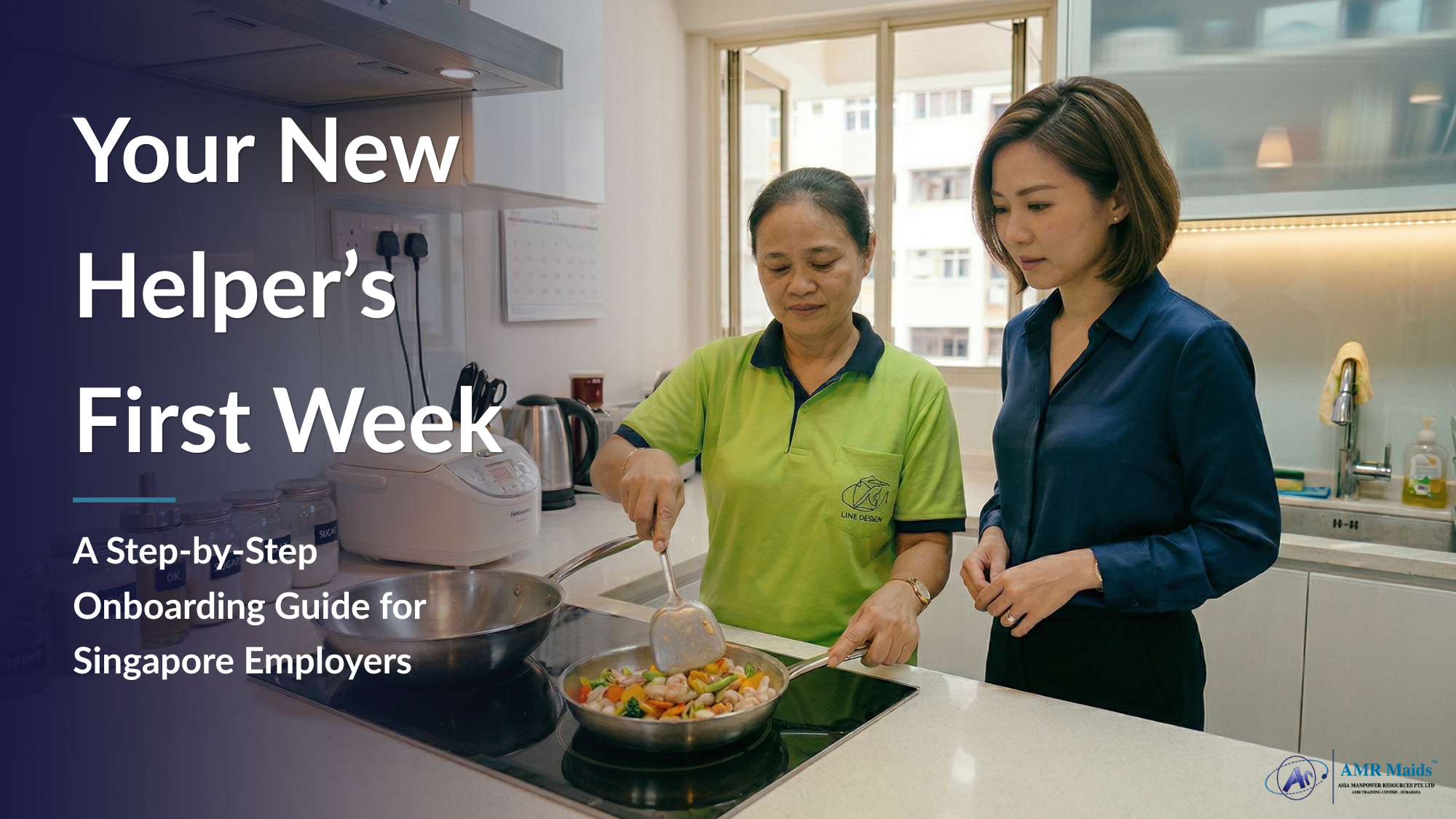
What you do in the first seven days with a new domestic helper determines how the next twelve months will go. A structured onboarding prevents misunderstandings, reduces early turnover, and gets your household running smoothly far sooner than a figure-it-out approach ever will.
- The first week is a high-investment window. Employers who run a structured Day 0 to 7 onboarding see better retention and fewer disputes than those who hand over tasks on Day 1 and hope for the best.
- Complete all MOM requirements within the first 72 hours. Work Permit, insurance, security bond, and medical exam. Miss these deadlines and you risk fines or work permit cancellation.
- Break training into short sessions using a demonstrate, observe, practise cycle. One task area per day. Laminated checklists near where the work happens. Don’t dump a week’s worth of instructions in one afternoon.
- If she’s a transfer helper, expect an adjustment period anyway. She knows Singapore, but she doesn’t know your household. Budget 3–5 days for basic routines and up to 2 weeks for specialised tasks.
- Daily check-ins are your most powerful tool. Five to ten minutes at the end of the day. Ask what went well, clarify gaps, and adjust. Small problems caught early don’t become big problems later.
- Put the probation in writing from Day 1. Clear duties, clear standards, clear replacement terms with the agency. Without this, you’re fully committed with no safety net.
- A good maid agency doesn’t disappear after placement. Post-deployment support, mediation, and replacement guarantees exist for exactly this phase. Use them.
If you’re still deciding between a transfer maid and an overseas hire, start with our guide: Need a Transfer Maid Fast? Here’s How to Hire One in Singapore Within 2 Weeks.
What Does a Good First Week Actually Look Like?
A successful first week means your helper can do three things by Day 7: follow the daily routine without constant prompting, handle 2–3 core tasks to an acceptable standard, and know what to do in an emergency.
That’s it. She doesn’t need to be perfect. She doesn’t need to cook your grandmother’s recipe from memory. She needs to be safe, oriented, and building confidence.
The mistake most employers make is expecting full independence after a day or two of verbal instructions. Even experienced transfer helpers who’ve worked in Singapore for years need time to learn your appliances, your cleaning products, your family’s rhythm. Rushing this phase is the single biggest driver of early placement failures.
Think of it like onboarding a new employee at work. You wouldn’t hand someone a laptop on Monday and expect a finished project by Wednesday. The same logic applies here, except the stakes are higher because she’s living in your home.
What Do I Need to Prepare Before She Arrives? (Day 0)
The prep you do before Day 1 determines whether the first week runs smoothly or turns into a series of avoidable problems. Set aside 2–3 hours the day before she moves in and get these done.
Her Room
She needs a private space, not a corner of the storeroom. MOM requires adequate shelter and privacy. That means a bed, storage, ventilation, a lockable door, fresh linens, and basic toiletries. A small bedside light and some hangers go a long way.
A small welcome gesture — a note, some snacks, or a simple “welcome” sign — costs almost nothing and sets the right tone from the start.
The House
Walk through every room she’ll work in. Label cleaning supplies in simple English or with pictures. Set up a designated, accessible storage area. Prepare a simple map of the house showing where key items are stored — this single step prevents days of “Ma’am, where is the…?” conversations.
The Paperwork
Put everything into one folder:
- Employment contract with probation clause, job scope, salary, rest days, and termination terms (use MOM’s standard contract as your baseline)
- One-page household reference sheet: family schedules, key phone numbers, nearest clinic, emergency numbers (995 for ambulance, 999 for police)
- House rules (distinguish between safety rules and preferences)
- Appliance instructions with photos
- Dietary requirements and allergy information
- Your agency’s contact details and the agreed replacement or refund terms
MOM Compliance Checklist
| Requirement | Details | Timeline |
|---|---|---|
| Work Permit | Applied via MOM’s FDW eService | Before she starts work |
| Security bond | S$5,000 for non-Malaysian FDWs (fulfilled via insurance guarantee at ~S$250–S$350) | Must be transmitted before arrival |
| Medical insurance | Minimum S$15,000/year for inpatient care and day surgery | Before Work Permit is issued |
| Personal accident insurance | Minimum S$60,000/year | Before Work Permit is issued |
| Settling-In Programme (SIP) | Required for first-time FDWs only; costs S$76.40 (paid by employer) | Within 3 working days of arrival |
| Medical examination | Screens for TB, HIV, syphilis, malaria | Within 14 days of arrival |
| Employers’ Orientation Programme (EOP) | Mandatory for first-time FDW employers | Before Work Permit application |
| Safety agreement | Signed between employer and FDW | Before deployment |
Day 0 Quick Checklist
- Private room ready with linens, toiletries, and a lockable door
- Cleaning supplies labelled, storage map prepared
- Employment contract finalised with probation terms
- Household reference sheet and house rules printed
- Appliance instructions with photos ready
- Security bond, medical insurance, and personal accident insurance confirmed active
- SIP scheduled (first-time FDWs only)
- Medical exam appointment booked (within 14 days)
- Agency replacement or refund terms confirmed in writing
How Should I Handle Day 1?
Day 1 is about settling in, not getting work done. Resist the urge to hand her a mop the moment she walks through the door.
The Welcome
When she arrives, give her time to unpack, freshen up, and get her bearings. Offer a light meal or snack. If she’s just travelled from overseas, she’s jet-lagged. If she’s transferring from another household, she’s carrying the emotional weight of leaving a familiar environment. A 30–60 minute buffer before anything else signals that you see her as a person.
After she’s settled, walk her through the home. Keep it to the essentials: her room, bathroom, kitchen, main living spaces, emergency exits, first-aid kit. Don’t try to cover everything. Overwhelming home tours create confusion, not confidence.
Demonstrate safety features physically. Show her how to lock doors, operate a fire extinguisher, and identify gas shut-off points. If you live in a high-rise HDB or condo, cover window safety rules explicitly.
Setting Up Communication
Language gaps are the number one source of first-week friction. Start a shared communication notebook — a physical notebook where either side can write questions, reminders, or feedback. This gives her a low-pressure way to raise issues she might be too shy to say out loud.
Introduce each family member individually and explain their schedules and needs. If there are children, supervise their first interaction. If there are elderly family members who need care, explain their conditions clearly.
The Previous Employer Conversation (Transfer Helpers)
If she’s transferring from another household, her habits, expectations, and work style were shaped by someone else’s preferences. Address this on Day 1: “Every household is different. This week we’ll show you how we do things here. It’s completely okay to ask questions if something is different from what you’re used to.”
This one sentence prevents the defensiveness that builds when you start correcting her methods later without context.
Day 1 Scripts
- “Welcome, take your time to settle in. We’ll eat together in about 30 minutes.”
- “This is your room. Please lock it whenever you want privacy.”
- “Every family does things a little differently. This week, we’ll walk through our routines together.”
- “Here is the emergency number list. Can you point to the hospital number so I know you can find it?”
- “If you have questions but feel shy, write them in this notebook and I’ll answer later.”
How Do I Train Her During the First Week? (Days 2–5)
The training approach depends on whether she’s a transfer helper or a fresh overseas hire.
Transfer helpers already have skills. The goal is to redirect those skills toward your standards. Use a show-then-adjust approach: ask her to do the task her way first, then show her what you’d change.
Fresh helpers need everything demonstrated from scratch. Use a demonstrate, observe, practise cycle: you show, she watches, then she does it while you observe.
Either way, the rule is the same: one task area per day. Don’t try to train cleaning, cooking, and childcare simultaneously. It doesn’t work.
Day 2: Cleaning and Laundry
Start with one room — the kitchen or a bathroom. Work alongside her. Show your preferred cleaning sequence: clear surfaces, wipe down, clean appliances, mop floors. Explain which products you use and which should never be mixed.
Create a simple chart distinguishing daily tasks from weekly tasks. Post it where she can see it. For laundry, walk through your sorting system, machine settings, and special-care items together. Laminated picture cards for washing machine settings are especially useful if there’s a language gap.
Day 3: Kitchen and Food
The kitchen is complex because it involves cleaning, storage, and cooking all in one space. Label refrigerator and pantry zones. Demonstrate safe food handling and storage. Make dietary requirements crystal clear: halal, vegetarian, allergies, no-go ingredients. Write them down and post them inside a cupboard door.
If she’ll cook, start with something simple under supervision: rice, a basic stir-fry, soup. Use recipe cards with photos, noting allergies and preferences. Don’t hand her a complicated recipe on Day 3 and expect dinner to be perfect.
Day 4: Schedules and Routines
Work with her to build a realistic daily schedule — not one you write alone and hand over, but one you build together. Cover morning routines, main cleaning tasks, childcare or eldercare duties (if any), break times, and end-of-day wrap-up.
Under MOM regulations, every FDW is entitled to at least one rest day per week. At least one rest day per month cannot be compensated. She must take it off. Make sure your schedule reflects this from the start.
Day 5: Specialised Tasks
If caregiving is part of the job, Day 5 is where you start introducing it — under supervision.
For childcare: Start with assisted routines. Meal prep for the kids, supervised bath time, school bag packing. Don’t leave her alone with your children until you’ve seen her handle each routine competently.
For eldercare: Walk through medication schedules, mobility support, dietary needs, and emergency protocols. If the care is complex, consider having the agency arrange additional training.
For errands: Take her on the first grocery trip yourself. Show your preferred stores, favourite brands, and budget. Use picture shopping lists at first. Clarify payment methods and receipt procedures.
For appliances: Many Singapore households use equipment that may be unfamiliar: induction stoves, washer-dryers, robot vacuums, smart-home devices. Place laminated instruction cards near each machine.
Need placement support that goes beyond Day 1?
What Should I Review at the End of the First Week? (Days 6–7)
Day 6 is for adjustments. Day 7 is for a proper review. Together, these two days determine whether Week 2 runs on momentum or on confusion.
Day 6: Fix What Isn’t Working
Go through the week’s schedule with her. Where were the bottlenecks? Which tasks took longer than expected? Adjust task durations, add buffer time, and write the changes down so you both have the same updated version.
If specific tasks are consistently difficult, figure out whether it’s a skill issue (she needs more practice) or a habit issue (she’s defaulting to her previous employer’s method). Skill gaps need more training. Habit mismatches need patient redirection: “I’ve noticed you fold towels this way. In our house, we do it like this. Can we practise together?”
Day 7: The First-Week Sit-Down
This is not a formal performance review. It’s a two-way conversation. Set aside 20–30 minutes and cover:
Safety
Does she know emergency procedures and the first-aid kit location?
Routine
Can she follow the daily schedule without constant prompting?
Core tasks
Is she handling 2–3 main tasks to an acceptable level?
Communication
Can she understand instructions and ask questions when unsure?
Comfort
Does she seem settled, or are there signs of stress or confusion?
Ask her directly: What felt manageable this week? What was confusing? What would make next week easier?
Helpers who feel heard during this review tend to stay longer. The ones who don’t get asked end up silently frustrated until something breaks.
Milestone Markers
| Milestone | What Success Looks Like |
|---|---|
| End of Week 1 | Safety awareness confirmed. Basic routines in place. Competence in 2–3 core tasks. All MOM requirements completed or scheduled. |
| End of Month 1 | Consistent daily routine. Basic emergency response. Specialised skills developing. Probation review completed. |
| End of Month 3 | Independent task management. Proactive problem-solving. Deeper specialisation. Long-term employment confirmed. |
How Do I Use the Probation Period Properly?
A probation period isn’t optional. It’s your most important safety net — especially for transfer placements. Without one, you’re fully committed from Day 1 with no structured way out.
Setting It Up
- Length: 2–4 weeks is standard. Some employers extend to 1–3 months for complex roles involving childcare or eldercare.
- Notice during probation: Typically 7 days, mutually agreed in the employment contract.
- Performance standards: Be specific. List the core duties, what “satisfactory” looks like, and how you’ll assess it.
- Agency terms: Confirm whether the agency offers a replacement or refund during the probation window, and get those terms in writing before Day 1.
Keeping a Record
During probation, maintain a short daily log:
- Tasks completed and quality level
- Feedback given and her response
- Any concerns or incidents
- Positive observations worth noting
Conduct a brief weekly review using this log. If the placement doesn’t work out, this record gives the agency clear grounds for a replacement and protects you if a dispute arises.
What MOM Rules Apply During the First Week?
Don’t rely solely on your maid agency for compliance. Understand the key rules yourself so you can spot gaps early.
Work Permit Conditions
Your helper must live at your registered address and can only do domestic work for your household. Deploying her to work for a relative, friend, or at a business is illegal under the Employment of Foreign Manpower Act (EFMA) and can lead to fines, imprisonment, or a permanent ban on hiring FDWs.
Rest Days
One rest day per week. At least one per month cannot be compensated — she must take it off. Remaining rest days can be worked by mutual agreement with compensation or a replacement day within the same month.
Salary
Pay within 7 days after the salary period ends. Pay in full. Deductions are only permitted with written consent, MOM approval, and within strict limits. Current market norms range from S$550 to S$900+ depending on experience, nationality, and skills.
Monthly Levy
The standard FDW levy is S$300/month for your first helper and S$450/month for additional helpers. Households with a child under 16, a member aged 67+, or a person with a disability may qualify for the concessionary rate of S$60/month.
Ongoing Medical Requirements
Your helper must undergo a six-monthly medical examination (6ME) throughout her employment. Mark these dates in your calendar — missed exams can result in penalties or work permit issues.
Insurance
- Medical insurance: Minimum S$15,000/year for inpatient care and day surgery
- Personal accident insurance: Minimum S$60,000/year
From 1 July 2025, MOM requires direct hospital billing by insurers and standardised exclusion clauses. Insurance typically costs S$360–S$500 for a 26-month policy.

How Do I Handle Communication and Cultural Gaps?
Language and cultural differences are manageable — but only if you address them proactively rather than hoping they’ll resolve themselves.
Practical Strategies
Show and tell at the same time. Don’t just explain. Demonstrate while you explain, then leave a written or visual reference.
Use the communication notebook. Both of you write in it. Questions, reminders, feedback, grocery lists. It becomes a shared reference that takes the pressure off verbal communication.
Place instructions where the work happens. Laminated cleaning checklist in the kitchen. Laundry guide near the washing machine. Appliance card near the stove.
Verify understanding by asking her to show you, not just tell you. “Can you show me how you’d clean this counter?” reveals far more than “Do you understand?”
Cultural Awareness
In many Southeast Asian cultures, direct disagreement with an employer is considered disrespectful. That means your helper might say “yes” or nod while not fully understanding what you’ve asked. This isn’t dishonesty. It’s a cultural communication pattern.
Explicitly invite questions. Reassure her that asking for clarification is encouraged. If your family observes specific practices (halal kitchens, vegetarian cooking, prayer times), explain these clearly and early. Small accommodations build genuine goodwill.
What Are the Biggest Onboarding Mistakes to Avoid?
Information Overload
Don’t try to cover everything in the first two days. Prioritise safety, essential routines, and one or two core tasks. Keep a “to cover later” list for everything else.
Premature Independence
Don’t expect full independence after brief verbal instructions. Basic cleaning might reach independence in 3–5 days. Childcare or eldercare could take 2–3 weeks. Use readiness indicators — consistent quality, fewer questions, proactive problem-solving — rather than strict timelines.
Ignoring Previous Employer Habits (Transfer Helpers)
Don’t correct her habits without context. Frame adjustments as “how we do it in our household” rather than “you’re doing it wrong.” Acknowledge that her previous training was valid. It just doesn’t match your preferences.
Skipping Feedback
Avoiding feedback to “be nice” does more harm than giving it directly. Normalise daily check-ins from Day 1. Keep them short, specific, and balanced: what’s going well plus what needs adjusting.
Not Using Your Agency
This is what you paid for. If communication breaks down, a task issue persists, or you’re unsure how to handle a situation, call your maid agency before the problem escalates. AMR Maids provides post-placement counselling, mediation, and replacement support during the probation period — but only if you use it.
Small problems caught early don’t become big problems later. The first week is where the next twelve months are made or unmade.
How Does a Good Maid Agency Support You After Placement?
A maid agency’s job doesn’t end when your helper moves in. The first 2–4 weeks are where the majority of placement failures happen, and that’s exactly when agency support matters most.
Here’s what AMR Maids provides after placement:
Pre-deployment training
All AMR Maids helpers complete structured training before deployment. Indonesian helpers go through a 40-day programme at our dedicated training centre in Surabaya, East Java, covering housekeeping, cooking, basic English, infant care, and eldercare.
Documentation and compliance
We handle Work Permit applications, insurance procurement, and security bond coordination end to end, ensuring everything is compliant with current MOM requirements.
Replacement guarantee
If the placement doesn’t work out during the probation period, we offer a replacement arrangement in line with MOM guidelines. No additional agency fee is charged. Third-party costs such as insurance and medical checks remain payable.
Mediation and counselling
If communication breaks down between you and your helper, we step in to mediate. This is especially valuable in the first two weeks when both sides are still adjusting.
Post-placement check-ins
We follow up regularly after deployment to catch issues early, before they turn into disputes or premature terminations.
Frequently Asked Questions
Ready to Onboard With Confidence?
AMR Maids has been matching Singapore families with professionally trained helpers from Indonesia, Myanmar, and the Philippines for over 10 years.
Get in touch
WhatsApp us at +65 8383 9448 or visit any of our three branches to discuss your needs.
Review matched profiles
We shortlist trained helpers whose skills and experience suit your household, not just whoever is available.
We handle the paperwork
Work permit transfer, insurance, security bond, and all MOM compliance requirements — end to end.
Ongoing support included
Replacement guarantee, post-deployment check-ins, and mediation if you need it. We’re with you beyond placement day.
About AMR Maids
AMR Maids (Asia Manpower Resources Pte Ltd) is a MOM-licensed maid agency in Singapore, founded in 2013. With over 10 years of experience and thousands of successful placements, we specialise in recruiting skilled domestic helpers from Indonesia, Myanmar, the Philippines, and Mizoram. All our Indonesian helpers complete a structured 40-day training programme at our dedicated training centre in Surabaya, East Java.
Our Branch Locations
| Branch | Address | Phone |
|---|---|---|
| Tampines | 11 Tampines Street 32, Tampines Mart, #01-02B, Singapore 529287 | +65 6241 7440 |
| Ang Mo Kio | Blk 713, Ang Mo Kio Ave 6, #01-4050, Singapore 560713 | +65 6518 9935 |
| Woodlands | Blk 548, Woodlands Drive 44, Vista Point, #01-29, Singapore 730548 | +65 6530 3650 |
Also serving Sengkang, Punggol & North-East Singapore families.
Hours: Mon–Sat 10:30am–7:30pm | Sun 10:30am–5:00pm
- Ministry of Manpower, Work Permit for Foreign Domestic Workers
- Ministry of Manpower, Settling-In Programme (SIP)
- Ministry of Manpower, Employers’ Orientation Programme (EOP)
- Ministry of Manpower, Rest Days and Well-being
- Ministry of Manpower, Six-Monthly Medical Examination (6ME)
- Ministry of Manpower, Foreign Domestic Worker Levy Concession
- Singapore Statutes Online, Employment of Foreign Manpower Act (EFMA)
- Ministry of Manpower, Complete Employer Guide to Hiring an MDW (PDF)
Disclaimer — This article is for general informational purposes only and does not constitute legal or employment advice. MOM regulations and fee structures may change; always verify with the Ministry of Manpower website for the most current information. Last updated: April 2026.